Shaving off dollars with Rails 8 Credentials on AWS ECS (12-Factor Trade-off)

· 5 min read

Akhan Zhakiyanov
Lead engineer

This year as part of my role I work more often with Rails apps running on AWS ECS. We aim to follow the 12‑factor app principles, loading configuration (including secrets) via environment variables to keep apps portable, stateless, and deployment‑friendly.

AWS ECS supports passing Secrets Manager secrets through environment variables, which injects secrets into containers at startup. While Secrets Manager provides excellent security and rotation capabilities, its pricing model adds up quickly with many secrets.

Our apps have on average 20–40 secrets per application stored in AWS Secrets Manager. Since we load secrets at container startup, storage costs dominate over API call costs, even with daily deployments.

Spec Kit with Amazon Q Developer: Findings and Quirks

· 4 min read
Akhan Zhakiyanov
Lead engineer

I recently explored further spec-driven development using GitHub's Spec Kit with Amazon Q Developer. This became possible after the Amazon Q Developer team merged PR #2799 (custom prompt support) and the Spec Kit team merged PR #600 (Q Developer integration).

Here's what I discovered along the way - the good, the quirks, and the gotchas.

Versions Used
  • Spec Kit: 0.0.64
  • Amazon Q CLI: 1.17.0
Amazon Q Developer CLI warning banner

Bridging Microsoft Spec Kit to Amazon Q Developer with MCP

· 6 min read
Akhan Zhakiyanov
Lead engineer
warning

This is just a workaround while waiting for native spec-kit support for Q Developer:

  1. Amazon Q Developer CLI Enhancement: PR #2799 was created to add custom prompt support
  2. 🚧 Spec Kit Implementation: PR #600 by Heejae Kim is implementing native Q Developer support

As outlined in GitHub's official announcement, developers can now use their AI tool of choice (Claude, Gemini, Cursor, Copilot, etc) for spec-driven development with GitHub's open source Spec Kit, but Q Developer users are left out of this unified experience.

We can address this missing piece with local stdio MCP server bridge while we wait for native support to land in Spec Kit.

Serverless OAuth2/OIDC server with OpenIddict 6 and AWS Aurora v2

· 12 min read
Akhan Zhakiyanov
Lead engineer

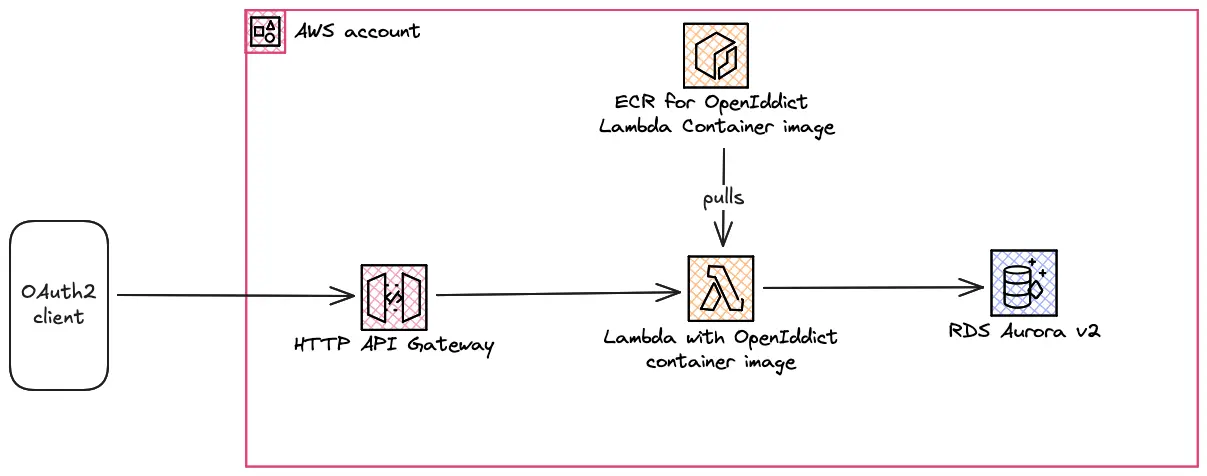
With the recent announcement of OpenIddict 6 and AWS Aurora Serverless v2's new scaling to zero capability, we have a perfect opportunity to build a cost-effective, serverless OAuth2/OpenID Connect server.

This setup will leverage AWS Lambda for compute and Aurora v2 PostgreSQL for storage, providing enterprise-grade security and scalability while maintaining optimal cost efficiency and only incurring cost when actually in use.

OpenIddict Serverless with Aurora v2 Architecture

Let's start by creating a new solution for our OAuth2/OIDC server.

Became AWS Community Builder 2024

· One min read
Akhan Zhakiyanov
Lead engineer

Today my application for AWS Community Builders 2024 program has been approved.

AWS Community Builder 2024 logo

Currently, the program covers the following technology areas: Containers, Data (databases, analytics), Developer Tools, Front-End Web and Mobile, Cloud Ops, Machine Learning, Network Content & Delivery, Security & Identity, and Serverless.

I've been selected in category - Containers. Looking forward to the journey ahead of me, and all the new experiences.

A big thanks to Maksim Skutin who motivated me to work on blog posts and submit this application.

Serverless OAuth2 server with OpenIddict 5 and AWS DynamoDB - Part 0

· 7 min read
Akhan Zhakiyanov
Lead engineer

After succesfully running ASP.NET 8 Minimal API with Lambda Container image it's time to run something real.

And just in December 2023 Kévin Chalet announced new version of OpenIddict, the library to build your own OAuth2 / OpenID Connect server in .NET.

Officially OpenIddict supports two implementations for persistance layer:

This time we will explore how to implement fully serverless OAuth2 server using OpenIddict 5 with Lambda Container image and persistance layer backed by AWS DynamoDB

note

Due to the large scope this will be series of posts covering the following aspects:

  • OpenIddict custom stores implementation with DynamoDB
  • Fully serverless OAuth2 server sample and setup for local testing
  • CDK custom component lib for OpenIddict
  • Cost analysis and comparison with Cognito, Auth0, etc
tip

You can find source code available at https://github.com/ahanoff/OpenIddict.DynamoDb

First let's review OpenIddict concepts and components.

Running ASP.NET 8 Minimal API on AWS Lambda with Container Image

· 15 min read
Akhan Zhakiyanov
Lead engineer
warning

Code samples were updated to run with x86_64 architecture

.NET 8 is finally here, since its release over a month ago.

Probably one of the much anticipated feature was Native AOT and its support for ASP.NET Core. Benefits coming along with it (such as minimized disk footprint, reduced startup time, and reduced memory demand) will lead to exploration how to run ASP.NET Core 8 apps in AWS Lambda.

Last year AWS gave us only two options to run .NET 7 Lambda functions: either container image or custom runtime. Now, in a twist for 2024, AWS is throwing its full support behind .NET 8 runtime, set to drop officially sometime in January. I think it's due to the fact that .NET 8 is an LTS release with a solid 3-year support plan.

And today I will show you the simplest way to run ASP.NET Core 8 in AWS Lambda without tearing everything apart!

info

This article targets experienced ASP.NET Core developers who considering to run their apps in serverless environment without major changes in existing programming model

TL;DR expected changes:

  • use Amazon.Lambda.AspNetCoreServer.Hosting package with .AddAWSLambdaHosting extension method
  • use AWS managed base image for .NET 8. Currently only public.ecr.aws/lambda/dotnet:8-preview is available
  • use CMD with assembly name instead of function handler string in Dockerfile

All codebase is available at: https://github.com/ahanoff/how-to/tree/main/aspnet8-minimal-api-lambda-container-image

First let's see what kind of objectives ASP.NET Core developers might have prior to investing their time and efforts into AWS serverless technology.

Docusaurus v3 deployment with AWS S3 and Cloudfront

· 6 min read
Akhan Zhakiyanov
Lead engineer

Docusaurus v3 is out, but official docs are still lacking deployment to AWS as option.

Let me fix this and guide you how to create most secure and up to date approach with AWS S3 and Cloudfront.

tip

TL;DR final approach:

  • private S3 bucket without website static hosting enabled
  • Cloudfront distribution with Origin Access Control (OAC)
  • Cloudfront Function to handle redirects to index.html

You can skip development instructions and go to full samples source code available at https://github.com/ahanoff/how-to/tree/main/docusaurus-3-deployment-with-s3-and-cloudfront

Docusaurus is static website generator, so let's review options AWS offers us to serve it.

Worry-free AWS ACM certificate DNS validation with Pulumi

· 4 min read
Akhan Zhakiyanov
Lead engineer

Quite often I need to create AWS ACM certificate and do DNS validation using Pulumi.

Pulumi aws.acm.CertificateValidation DNS example only show basic and naive implementation:

  • hardcoded single domain validation ¯_(ツ)_/¯
  • will fail if you try to validated wildcard and apex domain simultaneously
* creating Route 53 Record: InvalidChangeBatch: [Tried to create resource record set [name='_f22110437fea5500aa0f8bf286aed7c7.howto.ahanoff.dev.', type='CNAME'] but it already exists]

Today I'll show how to create validation that works for any domain

note
  • I will use howto.ahanoff.dev domain as example
  • I will use Pulumi with Typescript

I will create AWS ACM certificate with the following conditions:

  • multi domain certificate
  • validates wildcard domain: *.howto.ahanoff.dev
  • validates apex domain: howto.ahanoff.dev

CI/CD Misconfigurations validation with Allero

· 3 min read
Akhan Zhakiyanov
Lead engineer
warning

https://github.com/allero-io/allero has been archived by its owner on July 19 2023

Recently with team members we discovered https://www.allero.io/ that does CI/CD security validation:

  • identify plain text passwords
  • identify potentially malicious code execution
  • etc

Despite me being quite sceptical about it initially it found one issue using default rules